
In every district of Kiev, there are three to five dental clinics within a kilometer radius. The situation is similar in Dnipro, Odessa, and Lviv. Competition in the dental niche is fierce, and patients have long been choosing clinics not based on the sign outside the entrance, but on Google search results. A person types in “dentistry near me” or “dental implant price” and makes a decision in thirty seconds. They either visit your website and make an appointment or scroll on to your competitor.
A dental website is not just a digital business card with an address and phone number. It is a tool that works instead of an administrator: it explains services, shows doctors, alleviates fears, and makes appointments. In this article, we will tell you how to build such a website — from structure to promotion. Our experience is based on real projects by the Estetic Web Design web studio, where medical websites are one of the key areas of focus.
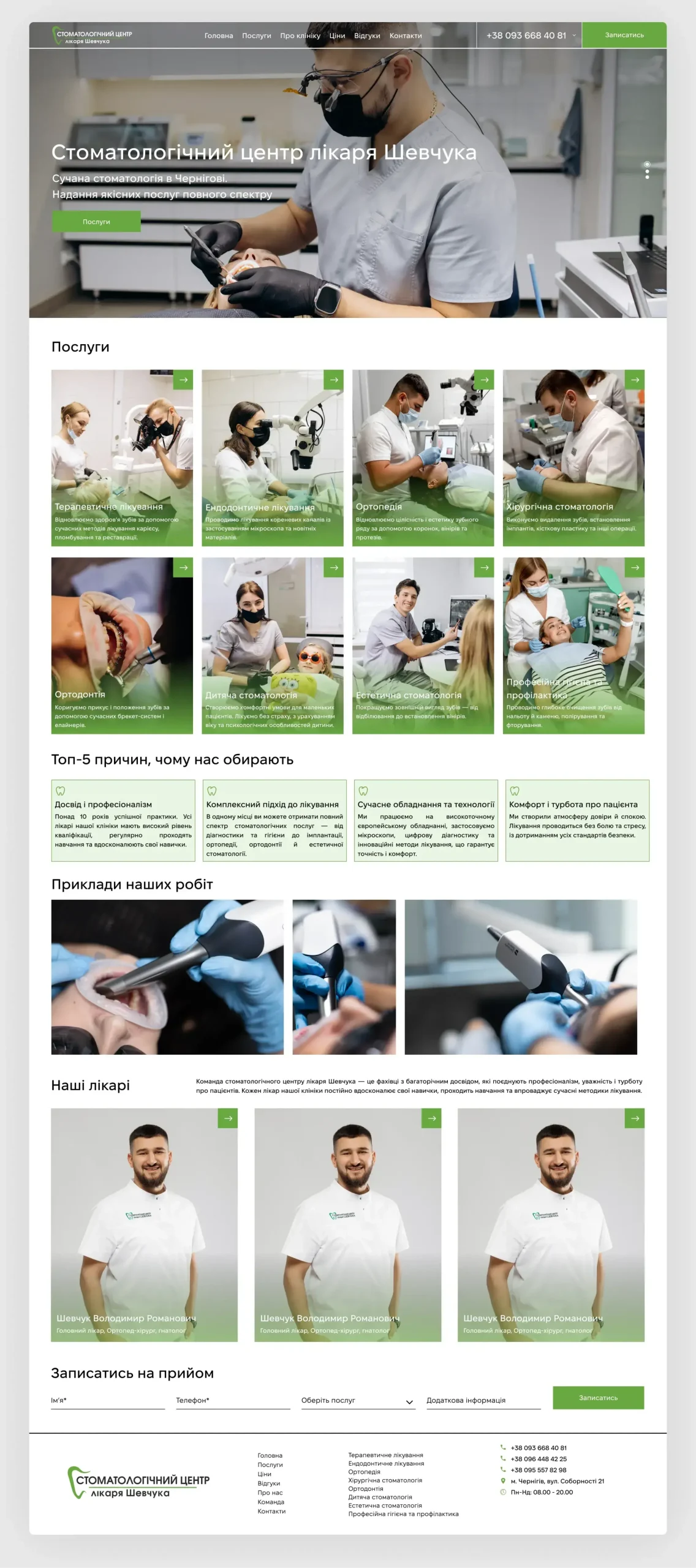
Home page: first impressions are everything
A patient who visits a clinic’s website evaluates it in three to five seconds. During this time, they need to understand three things: where they are, how they can be helped here, and how to make an appointment. It sounds simple, but most dental websites fail this test — they greet visitors with stock photos of smiling models and the text “Welcome to our clinic.”
An effective dental clinic homepage is built on a different logic. The first screen should display the clinic’s name, location (district or address), main specialization, and an appointment button. Below that is a brief list of advantages (not “individual approach,” but specifics: “in business since 2012,” “7,400 implants installed,” “free diagnostics”). Next are services with prices, the team of doctors, patient reviews, and contact information with a map.
A professional website design for medical topics should inspire trust, not excitement. Calm colors, high-quality photos of real interiors, clear typography. No aggressive banners, pop-ups with “50% off!” and animated teeth. Patients are looking for a doctor, not entertainment.
Service catalog: not just a list, but a system of persuasion
The biggest mistake dental websites make is having a list-format services page: “Therapy. Surgery. Orthodontics. Implantation.” No explanations, no prices, no reasons to choose you specifically. Patients see this list, don’t understand the difference between you and the clinic around the corner, and go where it’s clearer.
Each service deserves its own page. And this page should answer the patient’s questions, not the doctor’s. Instead of “Endodontic root canal treatment,” write “Tooth canal treatment: how it works, how much it costs, and whether it will hurt.” Add an approximate price or price range, the stages of the procedure, before/after photos (with the consent of patients), and answers to typical questions.
This approach solves two problems at once. First, it alleviates anxiety and brings the person closer to making an appointment. Second, it creates pages that appear in search results for specific queries, such as “how much do veneers cost in Kiev” or “all-on-4 implant price.” This is exactly how SEO optimization works for medical websites—through useful content that responds to real patient queries.
The medical team page: trust through familiarity
People don’t go to clinics—they go to doctors. The team page is one of the most visited pages on dental websites. And here, it is critically important to present the doctors correctly.
What you need: a high-quality portrait photo (not a selfie or a group photo from a corporate event), your specialization, work experience, education and professional development, a brief personal detail (hobby or motivation — “I practice pediatric dentistry because I am convinced that the first visit to the doctor shapes a person’s attitude towards health for life”). This transforms the abstract “dentist” into a real person whom you want to trust.
Ideally, it should be possible to make an appointment with a specific doctor directly from their profile page. This increases conversion rates and simplifies communication for the administrator. This functionality is standard for high-quality website development for medical clinics and private doctors — and it really works.
Patient reviews: social proof that sells
82% of people read reviews before choosing a doctor — this is a statistic that is difficult to ignore. On a dental website, reviews should be prominently displayed: on the home page, on the services pages, and on the doctors’ profiles.
But simply posting the text “Thank you, everything is great!” is not enough. A strong review contains details: what problem was solved, who treated you, what you liked about the process. Even better are reviews with photos or video reviews. Take a look at how our customers’ reviews work — detailed, with context, they dispel doubts more effectively than any advertisement.
Integrate a widget with Google reviews into your website. This kills two birds with one stone: patients see real ratings, and Google takes activity on Google Business Profile into account when ranking local search results.
Online appointment booking: removing the barrier between patient and chair
A phone call is a barrier, especially for a young audience that is used to doing everything on screen. Online registration on the website increases the number of applications by 25-40% — proven on our clients’ projects.
The registration form should be as simple as possible: name, phone number, desired service, convenient time. There is no need to ask for an email address, date of birth, or medical history at the initial registration stage—this can be off-putting. Ideally, the form should be integrated with the clinic’s CRM, and the appointment should automatically be added to the doctor’s calendar.
The “Sign Up” button should be accessible from any page of the website — in the header, in the sticky menu on the mobile version, after the services and reviews section. Comprehensive turnkey website development for dentistry always includes a well-thought-out system for converting visitors into appointments.
How patients will find your website
A beautiful website without traffic is like an expensive advertising brochure that no one sees. There are three channels for attracting customers in dentistry, and ideally, you need all three.
The first is local SEO. Optimization for queries such as “dentistry + district/city,” registration with Google Business Profile with photos, schedule, and reviews, and creation of content for patients’ informational queries. Comprehensive website promotion provides a steady stream of patients without monthly advertising costs, but results appear in three to six months.
The second is contextual advertising in Google Ads. This gives quick results: launch a campaign and you’ll start getting inquiries. For new clinics or when launching new services (such as aligners or digital implantation), advertising brings in the first patients within the first week. The downside is that you pay for each click, and when you stop spending your budget, the traffic disappears.
The third is content marketing. A blog with articles such as “How to choose an implant?”, “What to do if your wisdom tooth hurts?”, “Veneers or crowns — which is better?” attracts people who are not yet ready to make an appointment but are already looking for information. You become an expert for them, and when the need arises, they will come to you.
Technical base: speed, safety, mobility
70% of patients search for dentistry services on their smartphones. If your website loads slowly or is inconvenient to use on mobile devices, you will lose most of your potential appointments. A loading speed of less than three seconds, responsive design, and buttons that are easy to press with your finger are basic requirements.
A reliable domain and hosting for the website ensure stable operation around the clock. This is critical for a medical website — a patient may be looking for a clinic at two in the morning with acute pain, and if the website is down, they will go to a competitor. An SSL certificate is mandatory: without it, Google will mark the website as dangerous, and patients will not trust the registration form with their personal data.
Once launched, a website requires constant attention. CMS updates, form checks, speed monitoring, backups — technical support for your website ensures that your patient acquisition tool will run smoothly.
A dental website that truly attracts patients consists of five elements: a clear structure with an emphasis on services and prices, a team of doctors with live portraits, real reviews, convenient online booking, and competent promotion. Remove any element, and the system will only work at half its potential.
If you are planning to create or update a website for your clinic, order a turnkey development from a team that understands the specifics of the medical niche. We will help you build a website that will work for your business every day — even when you are on vacation.